Loading market dashboard

State Street Technology Select Sector SPDR ETF
XLKFinancial ServicesAMEXUS
Loading disclosure news
News and disclosures filtered by period, publisher, and event group.
Select a headline to open the full news page in the app.
Ten thousand dollars dropped into Technology Select Sector SPDR Fund (NYSEARCA:XLK) at the close on December 31, 2025 was worth about $13,434 at the close on June 4, 2026. The same ten grand in SPY was worth about $11,102. That is the entire "three to one" story, 34% for the tech SPDR against 11% for... $10,000 Invested in XLK on New Year's Eve Is Worth $13,434 Today
Ten thousand dollars dropped into Technology Select Sector SPDR Fund (NYSEARCA:XLK) at the close on December 31, 2025 was worth about $13,434 at the close on June 4, 2026.

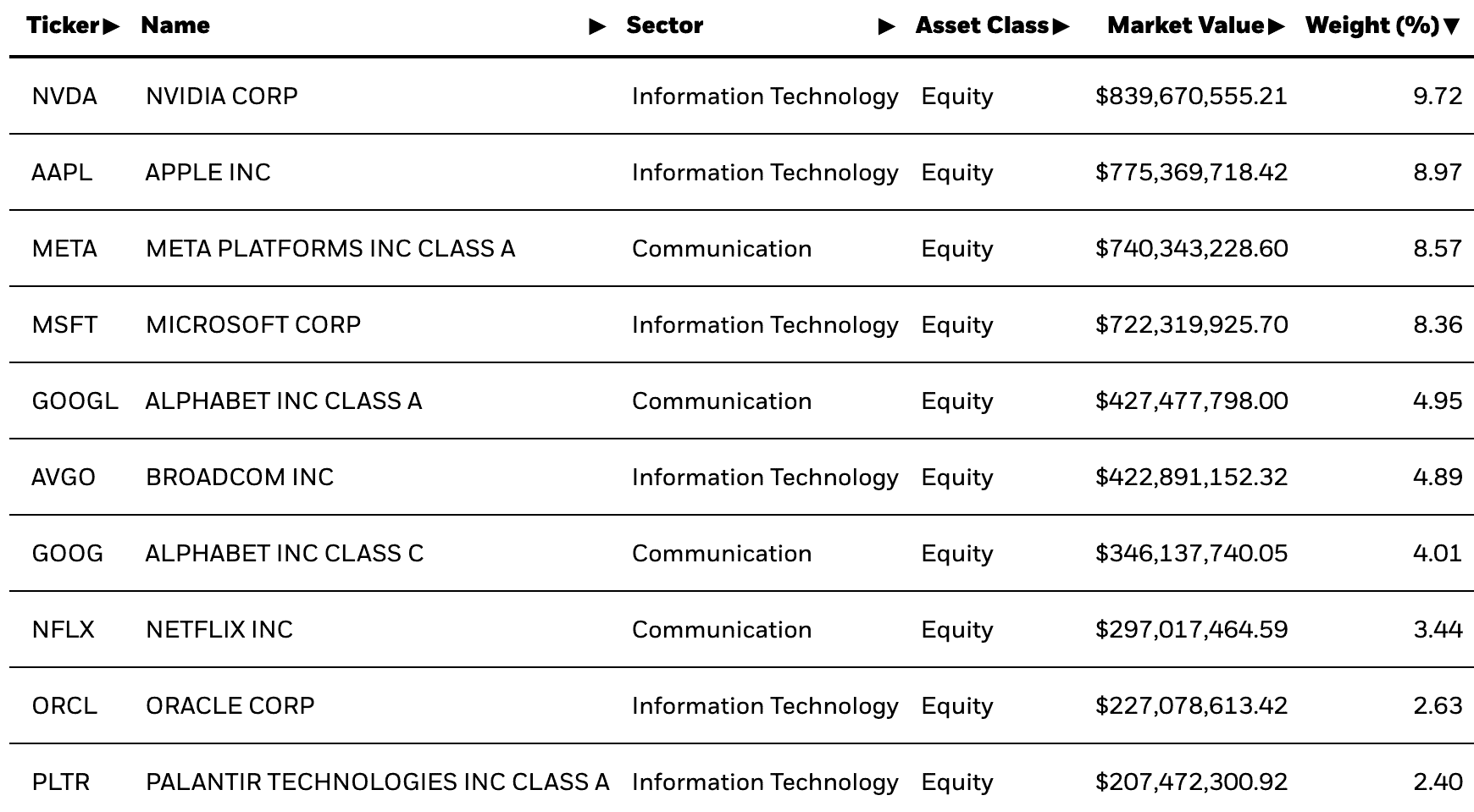
State Street Technology Select Sector SPDR ETF offers a significantly lower expense ratio and higher dividend yield than iShares U.S. Technology ETF. iShares U.S. Technology ETF holds 139 securities compared to the more concentrated 72-stock portfolio of State Street Technology Select Sector SPDR ETF.

Just three SPDR sector ETFs ended May in positive territory as an artificial intelligence-driven surge in technology stocks helped to carry the S&P 500 to a 5.1% gain for the month, even as eight of the index's 11 sectors finished lower.

Tech ETFs with heavy exposure to NVDA gain attention, as the company enters the PC market with its RTX Spark AI superchip.
The proposals include a new act to bolster advanced chip manufacturing and homegrown cloud computing.
Iran deal hopes, AI-fueled tech gains and Dell's upbeat outlook lifted stocks to record highs, while inflation fears and space-stock volatility persisted.

U.S. stocks climbed to fresh record highs by midday Friday as investors piled further into the artificial-intelligence trade following a blockbuster forecast from Dell Technologies Inc.

Compare expense ratios, diversification, and risk profiles as these two tech giants take distinct approaches to capturing growth across the sector.
One ETF delivers a higher dividend yield and sharper price swings, while the other boasts a massive asset base and broader sector coverage.
Expense ratios and dividend yields set these two tech ETFs apart, while portfolio concentration and sector exposure reveal key differences for investors.
One major stock market sector had a jaw-dropping turnaround.

Family offices poured more than $3 billion into tech, media, and telecom companies. But materials attracted the most capital—$4.8 billion.

NVIDIA's post-earnings dip spotlights ETFs loaded with NVDA exposure as investors weigh booming AI demand against supply-chain risks.

Microsoft's Maia AI chip talks with Anthropic spotlight tech ETFs as a diversified way to tap the AI-driven custom silicon boom.

CFRA Research senior vice president and head of technology Angelo Zino explains why Nvidia, AMD, Microsoft and Meta remain top ‘strong buy' picks amid the ongoing AI-driven tech rally on ‘Making Money.' #fox #media #breakingnews #us #usa #new #news #breaking #foxbusiness #makingmoney #ai #technology #tech #stocks #markets #investing #nvidia #amd #microsoft #meta #wallstreet #artificialintelligence #semiconductors #bigtech

Finding the right sectors is getting harder. Inflation, rising rates, and narrow market leadership combine to reshape the investing landscape.

NVIDIA's massive buybacks, dividend hike and booming AI growth put Nvidia-heavy ETFs like SMH, XLK, QQQ and SOXX in focus.

The pitch on the Vanguard Information Technology ETF (NYSEARCA:VGT) is sector breadth. You pay nine basis points, you get the entire information technology sleeve of the U.S. market, roughly $125 billion in assets aggregated into one ticker. So a 50 year old tilting their 401(k) toward tech with VGT thinks they own a sector. They... VGT Looks Like a Diversified Tech Bet Until You Realize Three Stocks Are 43 Percent of It
Sometimes it feels like it's Nvidia's world, and we are all just living in it. As we brace for the firm's latest earnings report coming Wednesday, we could say that Nvidia (NVDA) earnings — and more importantly, its forward guidance — have become much more than a par-for-the-course quarterly disclosure.

In a reversal from the SaaS-pocalypse, software is finding strength while AI memory names like Micron (MU) and SanDisk (SNDK) are selling off. Kevin Hincks explains how this all plays into the big picture for tech as Nvidia (NVDA) readies to report earnings Wednesday.

VanEck Semiconductor ETF (SMH) and other semiconductor ETFs surged 200%+ in 13 months, now showing signs of a potential technical top. Trees don't grow to the sky, as they say. The recent 45% rally in SMH over six weeks is historically rare for semiconductors, resembling an 'Empire State Building' top formation (what I call it). Technical indicators like PPO highlight an extremely stretched move, raising caution for investors exposed via SMH, SOXX, QQQ, DIA, and S&P 500.
U.S. equities opened the new trading week on a split footing on Monday as a sharp unwind in AI-infrastructure names dragged the Nasdaq 100 down by over 1%, while energy, communications and insurance shares cushioned the broader market.

There are several different paths to retiring on dividends. However, they all have major drawbacks. I share an approach that I have honed over time that seeks to bring out the best of each strategy and minimize its deficiencies.

Whenever an exchange-traded fund passes a critical milestone for assets under management, it's often worth taking a closer look. After all, there's frequently a good reason an ETF has managed to amass such an impressive amount of funds.

U.S. natural gas futures were higher, fluctuating from one day to the next as the market weighs fading heating demand against a gradual pickup in cooling needs.

Cooling Middle East tensions, solid jobs data and AI momentum are reviving risk appetite. Here are ETFs riding the risk-on wave.
XLK hits a fresh 52-week high as AI momentum, Big Tech spending and strong corporate earnings boost the technology sector.
"Sell in May" may no longer work. Strong earnings, AI optimism and easing Iran fears could keep markets rising in May 2026.

One ETF offers nearly four times the number of tech holdings, while the other leads in five-year growth and resilience. Compare their structures and performance.
Q1 earnings: fantastic (but with a caveat)

The S&P 500 managed double-digit growth in April. When double-digit monthly growth has happened in the past, it's traditionally signaled the start of an accelerating momentum cycle.

For retirees who do not want to do deep due diligence into picking individual stocks, there are attractive alternatives for still generating attractive income. I detail a simple portfolio for generating a 7%+ yield along with dividend growth. The portfolio combines monthly income machines with dividend growth powerhouses, providing an attractive combination of current income and long-term dividend growth.

Investing in technology is now essential as tech sector earnings and profit margins surge, driven by AI infrastructure capex and data center buildouts. Despite high growth and profitability, the tech sector trades at only a modest premium to the S&P 500, with a PEG ratio of 0.8x. Dividend-focused ETFs like TDIV and TDVI offer exposure to tech's upside while providing income, making them attractive for income-seeking investors.

On Thursday, Apple (AAPL) released its highly-awaited Q2 2026 earnings report. While all mega-cap tech earnings calls are closely watched, this one was especially crucial, considering it came after news that Tim Cook is stepping down as CEO of Apple.

The world's four largest hyperscalers unveiled plans to spend more than $700B in capex, with large portions tied to investments in AI data centers and infrastructure. The AI market is expected to reach $3T by 2033, a CAGR of 30%, as adoption accelerates and use cases expand across a wide range of industries. AI infrastructure providers are well positioned to gain from big tech's data center expansion and demand for high-performance computing.

Strong Q1 earnings momentum continues as S&P 500 firms beat estimates. Tech, Energy lead growth; full-year 2026 outlook stays robust.

If you're interested in broad exposure to the Technology - Broad segment of the equity market, look no further than the Invesco S&P SmallCap Information Technology ETF (PSCT), a passively managed exchange traded fund launched on April 7, 2010.

Compare the trade-offs between concentrated chip exposure and diversified tech holdings, including fees, volatility, and long-term growth outcomes.
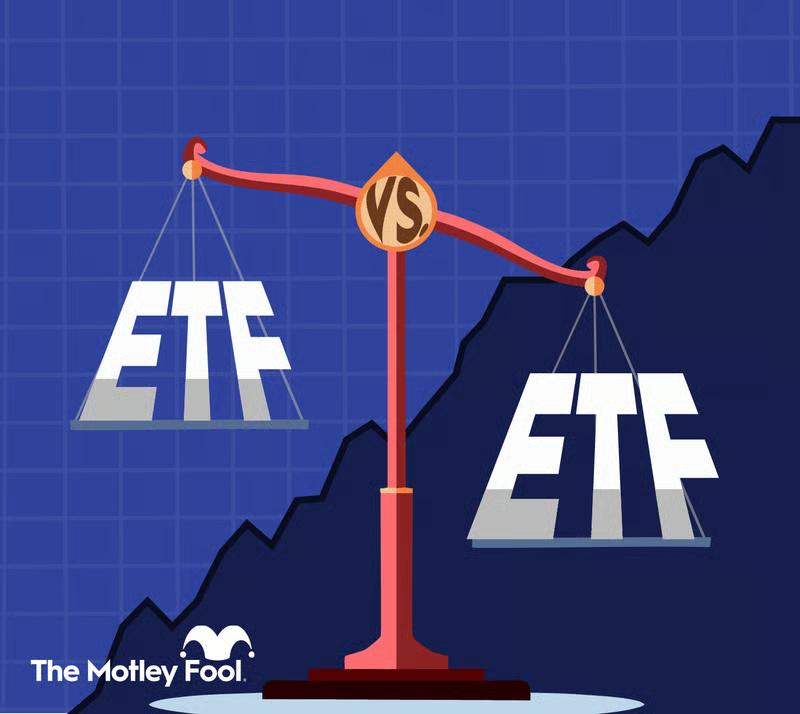
iShares U.S. Technology ETF manages more than double the number of holdings found in State Street Technology Select Sector SPDR ETF. State Street Technology Select Sector SPDR ETF maintains a significantly lower expense ratio and higher dividend yield than the iShares alternative.

Launched on October 21, 2013, the Fidelity MSCI Information Technology Index ETF (FTEC) is a passively managed exchange traded fund designed to provide a broad exposure to the Technology - Broad segment of the equity market.

Looking for broad exposure to the Technology - Broad segment of the equity market? You should consider the State Street SPDR NYSE Technology ETF (XNTK), a passively managed exchange traded fund launched on September 25, 2000.

It's that time again: some huge names in technology and the broader stock market will report their earnings this week. With so much uncertainty around AI and the economy in general, markets will be watching results closely.

NVIDIA reclaims $5T crown as chip rally surges; strong AI outlook, bullish estimates, and ETF exposure keep momentum alive.

Competing asset managers tend to offer very similar ETF lineups, especially when it comes to sector funds.
Microsoft's $18B Australia AI push boosts its long-term outlook, but ETFs with MSFT exposure may offer a smarter, diversified way to tap the growth story.
The inverse relationship between oil prices and stock prices broke today.

Investors got a dose of good news after hours, but concerns about the war could be fading.

Technology Select Sector SPDR Fund (NYSEARCA:XLK - Get Free Report)'s stock price hit a new 52-week high during mid-day trading on Friday. The stock traded as high as $154.62 and last traded at $154.19, with a volume of 1385250 shares changing hands. The stock had previously closed at $152.02. Technology Select Sector SPDR Fund

Dan Ives, Wedbush Securities, joins 'Power Lunch' to discuss what Ives learned from a recent trip abroad, the energy complex and much more.

Technology Select Sector SPDR Fund TodayXLKTechnology Select Sector SPDR Fund$150.89 +0.59 (+0.39%) As of 09:45 AM Eastern This is a fair market value price provided by Massive. Learn more.52-Week Range$92.59▼$152.99Dividend Yield0.50%Assets Under Management$96.00 billionAdd to Watchlist
If you're interested in broad exposure to the Technology - Broad segment of the equity market, look no further than the State Street Technology Select Sector SPDR ETF (XLK), a passively managed exchange traded fund launched on December 16, 1998.

Chris McGratty, KBW head of U.S. bank research, joins 'Closing Bell' to discuss the upcoming slate of bank earnings, which stocks McGratty favors and much more.

Ceasefire headlines triggered a relief rally in chip and AI stocks, with Intel up 22%, Micron up 13%, and Broadcom up 20% over five days. Oil stocks like ExxonMobil and Chevron declined on peace hopes, but remain significantly up year-to-date; crude oil prices are still elevated versus start-of-year levels.

Most income investors are unknowingly missing two of the best-performing sectors of the past decade. These two investments fill that gap while still paying 10–13% yields. They also benefit from superior tax efficiency and skilled management teams.

Fear has fueled a broad market selloff amid Iran war uncertainties, hitting many stocks despite strong fundamentals and earnings growth upside. Panic selling, however, has historically led to financial setbacks. The market has delivered positive returns following most major geopolitical shocks since Pearl Harbor. S&P 500 tech sector earnings are expected to grow by 45% in Q1 2026, a forecast that has steadily improved in the past three months.

Volatility rises amid Iran tensions, but long-term investing still wins. Here are 5 ETFs to buy and hold through uncertainty and build lasting wealth.

US megacap technology stocks, long the driving force behind a bull run spanning more than three years, are undergoing a sharp valuation reset as a mix of geopolitical tensions, rising yields, and questions around artificial intelligence spending weigh on sentiment. The pullback has intensified in recent weeks, with the sector already under pressure before the escalation of the Iran conflict.

Shares of Technology Select Sector SPDR Fund (NYSEARCA:XLK - Get Free Report) crossed below its 200-day moving average during trading on Friday. The stock has a 200-day moving average of $142.36 and traded as low as $129.58. Technology Select Sector SPDR Fund shares last traded at $129.92, with a volume of 15,883,191 shares. Technology

XLK and FTEC charge the same low expense ratio but differ in size, with XLK managing far more assets. FTEC holds nearly four times as many stocks as XLK, offering slightly broader tech sector exposure.