Loading market dashboard

State Street SPDR S&P 500 ETF Trust
SPYFinancial ServicesAMEXUS
Loading disclosure news
News and disclosures filtered by period, publisher, and event group.
Select a headline to open the full news page in the app.
$10,000 dropped into the iShares Asia 50 ETF (NYSEARCA:AIA) on the last trading day of 2025 was worth roughly $15,267 by the close on June 3, 2026. That is the kind of half-year a US large-cap investor doesn't get out of the SPDR S&P 500 ETF Trust (NYSEARCA:SPY) in a calendar year, let alone five... $10,000 in Asia's Biggest 50 Stocks Became $15,267 in Five Months: Here's Why

$10,000 dropped into the iShares Asia 50 ETF (NYSEARCA:AIA) on the last trading day of 2025 was worth roughly $15,267 by the close on June 3, 2026.
It is a good time to reduce risk. High-yielding securities could be the first in line for elimination. However, some high-yielding picks are just built differently.
Inflation relentlessly erodes purchasing power, making dividend growth essential for income investors to maintain real income. A barbell strategy—combining moderate-yielding dividend growth stocks/ETFs and 6.5%+ yielding investment grade preferreds—offers both growth and current income. AI-driven capex by large-cap S&P 500 firms is powering economic growth and masking weakness among lower-income consumers.

Weekly Market HighlightsThe stock market experienced significant pressure this week, with 6,184 declining stocks compared to 3,382 advancing stocks, indicating
Although the S&P 500 reached multiple record highs early in the week, its upward momentum was halted on Friday by the stronger-than-expected jobs report, which triggered the index's largest single-day drop since April 2025. This sharp plunge served as the primary driver behind the 2.6% weekly loss, ultimately snapping the index's nine-week winning streak.

A remarkable two-month sprint higher for major stock-market indexes encountered its first major hiccup on Friday as the Nasdaq Composite plummeted more than 1,121 points — the biggest one day point drop on record, according to Dow Jones Market Data.
Marvell Technology, which makes parts and products needed for the AI infrastructure boom, is joining the S&P 500 It is the latest semiconductor company to be added to the benchmark.
Chipmaker Marvell Technology is set to join the benchmark S&P 500 index, S&P Dow Jones Indices said on Friday.

The Amplify CWP Enhanced Dividend Income ETF uses an active selection process that favors quality, dividend-growing large caps, with covered calls on individual holdings and a 4.78% distribution rate. DIVO's lower volatility (8.97% vs. S&P 500's 11.82%) and sector constraints position it as a stabilizer during speculative or mean-reverting markets. Considering the imbalance between the S&P 500 mega caps and the other securities, I think that DIVO in the portfolio can stabilize expected returns.
Investors heavily favored large-cap core equity ETF building blocks in May 2026. Simultaneously, investors bolstered portfolios with ultra-short-term fixed income allocations and targeted thematic active exposure last month Key Takeaways Broad-market S&P 500 ETFs captured the largest share of inflows, led by Vanguard's VOO, with over $18 billion in monthly net flows.
Welcome to the age of trillions.
A $10,000 stake in Goldman Sachs Future Tech Leaders Equity ETF (NASDAQ:GTEK) on the last trading day of 2025 was worth about $15,200 at Monday's close, with the fund up 52% year to date through June 1, 2026.
Marvell, Reddit and a mortgage “dark horse” could make the cut during the next quarterly rebalancing of the benchmark index.

The May employment data landed with a thud for bond bulls, with implications for Treasury proxies like the iShares 20+ Year Treasury Bond ETF (NASDAQ:TLT).
Few investors command more credibility than Warren Buffett.

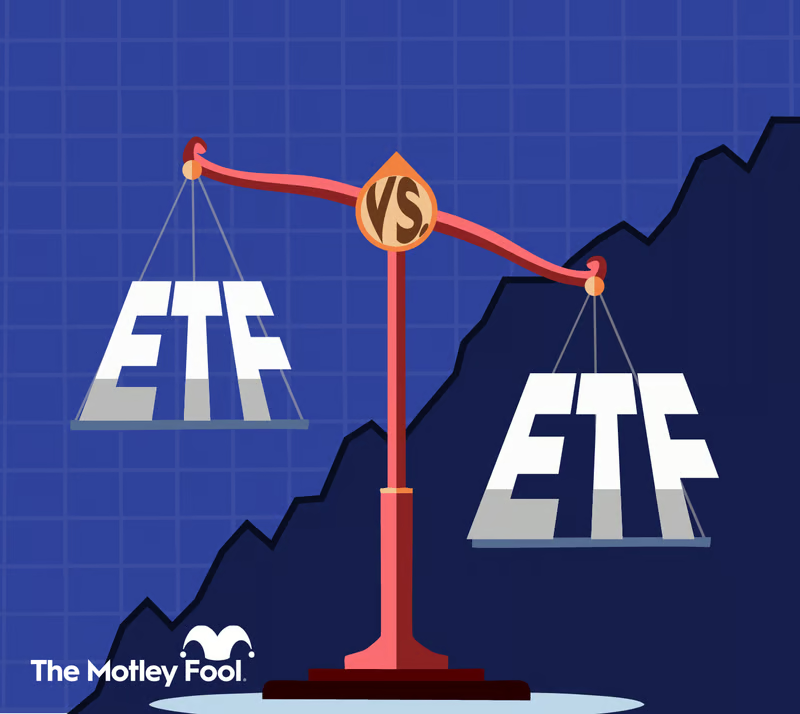
Compare two giants tracking the same index, each with unique strengths for investors seeking broad U.S. equity exposure and efficient portfolio building.
A $10,000 stake in the iShares MSCI Taiwan ETF (NYSEARCA:EWT) on the last trading day of 2025 was worth about $16,178 five months later, after the fund rose from about $64 to $103 between December 31, 2025 and May 29, 2026.
Karsan points investors toward diversification and risk-adjusted strategies that, in his view, could potentially deliver 10-15% annual returns regardless of market conditions.

S&P Dow Jones Indices considered whether to loosen index requirements but opted to keep its policies unchanged.
Some potentially volatile earning reports land next week, led by Oracle ORCL+2.61%, which had a 35% move after earnings three quarters ago. Additionally, Chewy CHWY-1.05% and RH RH+0.52% have also been big movers after reporting earnings.

The S&P 500, Dow Jones Industrial Average (Dow), and Nasdaq Composite are all stock market indexes used to measure the performance of various aspects of the U.S. stock market.

Starting Monday, some of the world's most popular ETFs may have to make room for SpaceX, OpenAI, Anthropic, and other money-losing tech giants once they go public, thanks to new index rules from S&P Dow Jones Indices.
I've been holding NVIDIA for over 15 years and Apple since 2012, so when financial advisor Wes Moss told a caller on The Clark Howard Podcast on June 2, 2026 that the S&P 500 is not what most people think it is, I paid attention. A listener named Tony from Utah had received a letter... Fidelity Just Warned 500-Stock Fund Owners. 35% to 40% of Your S&P 500 Moves Come From 7 Mega-Cap Stocks

If you put $10,000 into United States Oil Fund (NYSEARCA:USO) on the last trading day of 2025, when it closed at $69.16, you were sitting on roughly $19,800 by the close on June 2, 2026, with USO at $137.27.

S&P 500 changes are likely to be announced on Friday, and Marvell is now vastly bigger than the next-largest eligible contender.
Here's how Vanguard S&P 500 ETF got so big and why the valuation of the S&P 500 is still the more important issue.

Tech stocks are balking at good sector earnings. That's a bit worrying.

The major index funds are near record highs, but one risk hiding in plain sight could change the math for new money.

A “dispersion trade” is being fueled by rising volatility for individual stocks while index volatility is falling — suggesting the risks of a selloff are rising
The powerful stock-market rally took a breather on Wednesday after a solid stretch of gains. As of the closing bell, the S&P 500 had wiped out its advance from earlier in the week, placing a lengthy weekly winning streak in jeopardy.
Comprehensive cross-platform coverage of the U.S. market close on Bloomberg Television, Bloomberg Radio, and YouTube with Romaine Bostick, Alexis Christoforous, and Isabelle Lee.
The S&P 500 likely completed its final rally wave near target, while worsening breadth divergences suggest a correction or larger multi-month decline may be underway.
The S&P 500 is trading above 30 times earnings for the first time in five years. Rising interest rates killed its previous rally, which peaked in late 2021 and early 2022.

Schwab US Large-Cap ETF remains a buy, offering diversified exposure to top global companies and outperforming the S&P 500 with a 29.6% annual return. SCHX is heavily weighted toward technology (34.26%), positioning it to capture AI-driven growth, while quarterly rebalancing enhances responsiveness to market changes. The ETF's broad holdings dilute individual stock impact, reducing volatility but potentially underperforming more concentrated tech indices like QQQ during strong rallies.

S&P 500 pulls back from record highs as oil nears $96 and Treasury yields rise. See how inflation fears and strong jobs data are pressuring stocks.
As Roberts put it, “What markets are pricing is the impact of that CapEx spending on the economy that generates the earnings.
The S&P 500 Index and its ETFs, like the SPY and VOO wavered today as market participants reacted to several important macro events from the United States and other countries. They have officially entered a bull market after rising by over 20% from the lowest point this year.

Buy 4 S&P 500 Best June Dividend Dogs

The U.S. stock market has entered a zone last seen ahead of the 1987 Black Monday crash after the S&P 500 recorded one of its strongest two-month rallies in modern history.
Markets can continue the climb but buyer beware
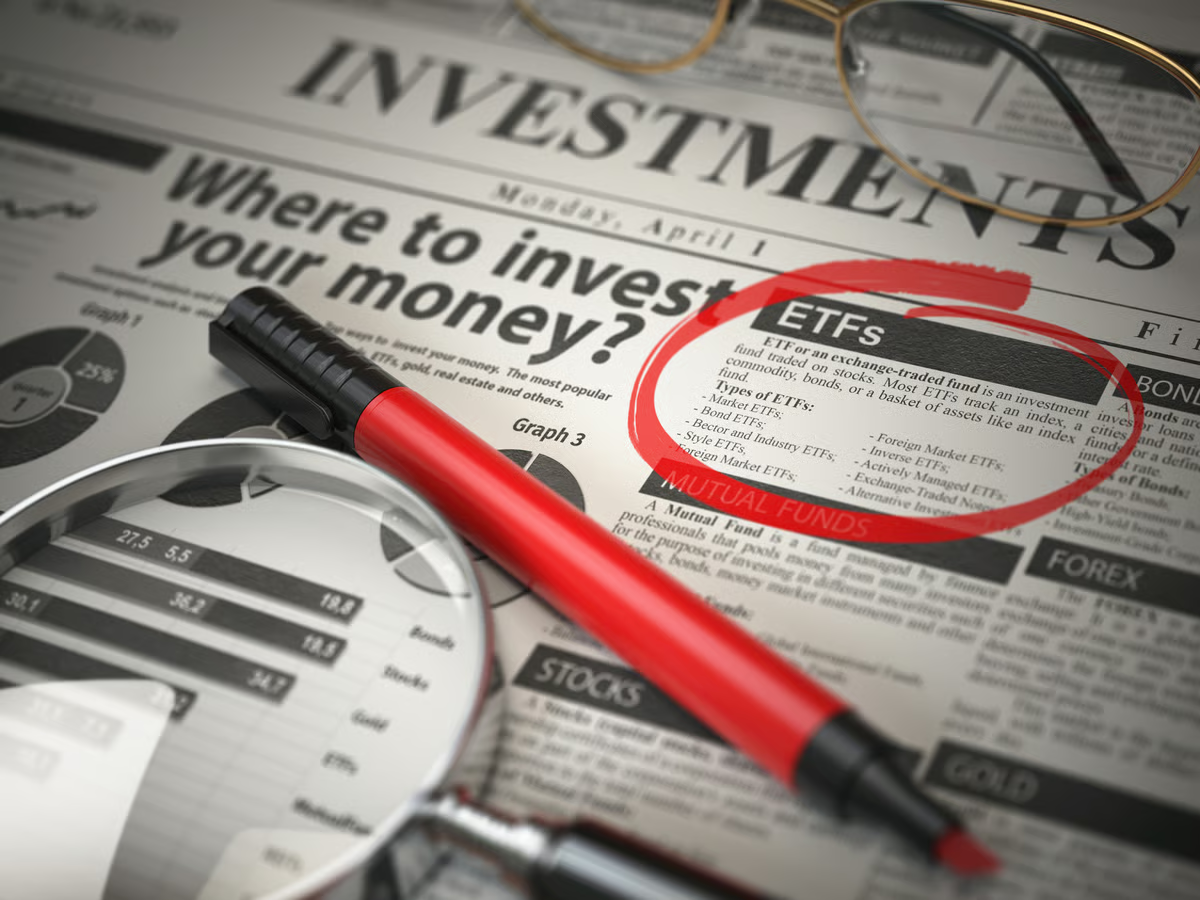
If you bought Invesco Solar ETF (NYSEARCA:TAN) on the last trading day of 2025 at about $49 and checked your account at Monday's close, your shares were worth about $71, a gain of about 45% in roughly five months.

U.S. stock futures were mixed on Wednesday, after a record close on Tuesday, as the Dow Jones and S&P 500 advanced but the Nasdaq 100 fell.
When markets run as fast and hard as they have since the start of April, you want to at least have your guard up a little. Things continue to fly higher and elevations are rising, meanwhile we are still at war, regardless of how close negotiations sound on a weekly basis, no deal is in site.

All three indexes have now closed at records five sessions in a row for the first time since February 2017.
The S&P 500 is one green day from its rarest streak since 1995. After the last eight, forward returns ran well below normal.

Every conversation about the cheapest way to own the S&P 500 lands on the same few tickers from the major ETF sponsors.
The S&P 500's latest string of records has come with a catch: Fewer stocks are participating in the rally.

Analysts have been raising their price targets on Broadcom stock. Will Q2 earnings justify the optimism?
S&P 500 hits a record high as chip stocks surge 4%. Nvidia, Marvell and HPE fuel the AI rally while Fed rate hike risks remain in focus.
The S&P 500 has rapidly climbed at an historic pace seen on these four occasions since WWII, according to Deutsche Bank Research.

Lance Roberts of RIA Advisors believes investors are underestimating a risk that has appeared more than once throughout market history. Speaking on a recent episode of Thoughtful Money with Adam Taggart, Roberts delivered a stark warning: "We will get into a lost decade again. That's almost a guarantee." Roberts' argument is not that a crash is imminent.... 'We Will Get Into a Lost Decade Again. That's Almost a Guarantee,' Says Top Portfolio Strategist

US indices pull back from record highs as Alphabet's $80B AI funding plan weighs on sentiment, while Nvidia and HPE help limit losses.
Roundhill S&P 500 Target 20 Managed Distribution ETF offers S&P 500 exposure via long call options with a 20% managed annual distribution. XPAY's simple structure and high payout suit income-focused investors, but long-term reinvestors are likely better off with SPDR S&P 500 ETF Trust. XPAY distributions are primarily return of capital, providing tax deferral benefits similar to or better than SPY's tax efficiency.
Our global markets watchlist tracks nine prominent indexes from economies around the world.
Vanguard's S&P 500 ETF is on the verge of becoming the first trillion-dollar ETF, extending its lead over SPY, highlighting the rise of passive investing.
Less than 10% of S&P 500 stocks have Strong Buy Quant Ratings. Using Seeking Alpha's stock screener, I found five with the strongest forward earnings growth. The S&P 500 index remains the most visible stock benchmark, accounting for 80% of market capitalization, and has reached new highs despite rising inflation and geopolitical uncertainty. Strong corporate earnings growth has helped fuel the S&P 500's rally in 2026, even amid skepticism from some investors over elevated valuations and exuberant AI-related spending.
This article provides an update on the monthly moving averages we track for the S&P 500 and the Ivy Portfolio after the close of the last business day of the month. The Ivy Portfolio The Ivy Portfolio is based on the asset allocation strategy used by endowment funds from Harvard and Yale.
Building on the last week's strength, the S&P 500 rose every day this week and set multiple new record highs. With a 1.6% weekly increase, the index secured its ninth straight weekly gain, matching its longest winning streak from 2023.

Last week's data tracked a shifting economic trajectory over the last several months. While the latest reading on first-quarter GDP confirms the economy started the year with steady growth, subsequent inflation metrics from April moved higher, heavily influenced by global geopolitical pressures.