Loading market dashboard
D-Wave Quantum Inc.
QBTSTechnologyNYSECA
Loading disclosure news
News and disclosures filtered by period, publisher, and event group.
Select a headline to open the full news page in the app.
Quantinuum, the Honeywell-backed trapped-ion quantum computing company, began trading on the NASDAQ today after pricing its IPO at $60 per share and raising $1.68 billion. On CNBC's Squawk Box this morning, CEO Rajeeb Hazra delivered the line that will define the debut: "It is not 10 to 15 years out. It's very much now. And... The Next Quantum Computing IPO CEO Just Told CNBC 'It Is Not 10 to 15 Years Out. It's Very Much Now'

Yesterday's Broadcom sell-off is spreading beyond AI stocks today, and entangling everything tech.

Quantum stocks have been battered, but one company already appears to be separating itself from the pack. The real question is whether Wall Street is paying attention.
Shares of D-Wave Quantum Inc (NYSE:QBTS) are trading lower Friday morning as traders continue to weigh fresh enterprise adoption headlines in a risk-off tape that's pressuring high-beta tech. Here's what investors need to know.

QBTS outlines a roadmap to 100 logical qubits by 2032, aiming for 1M+ operations and major error reductions through its dual-rail architecture.

D-Wave Quantum Inc. (QBTS) Analyst/Investor Day Transcript

PALO ALTO, Calif.--(BUSINESS WIRE)--D-Wave Quantum Inc. (NYSE: QBTS) (“D-Wave” or the “Company”), the only dual-platform quantum computing company providing both annealing and gate-model systems, software and services, today announced that it has been awarded the Great Place To Work Certification™ for 2026. The recognition is based entirely on employee feedback and reflects the strength of D-Wave's culture during a period of rapid growth and innovation, as the Company continues to expand the te.

D-Wave shares have surged alongside the broader market, boosted by Nvidia's new Ising AI models and a $100 million federal funding award. Despite the stock rally, D-Wave's financials remain concerning, with just $24.6 million in revenue last year against an operating loss exceeding $70 million.

Wall Street has a quantum computing problem, and it's not about qubits. It's about how the market prices the entire sector as a single trade.

The Department of Commerce just took equity stakes in nine quantum computing companies.
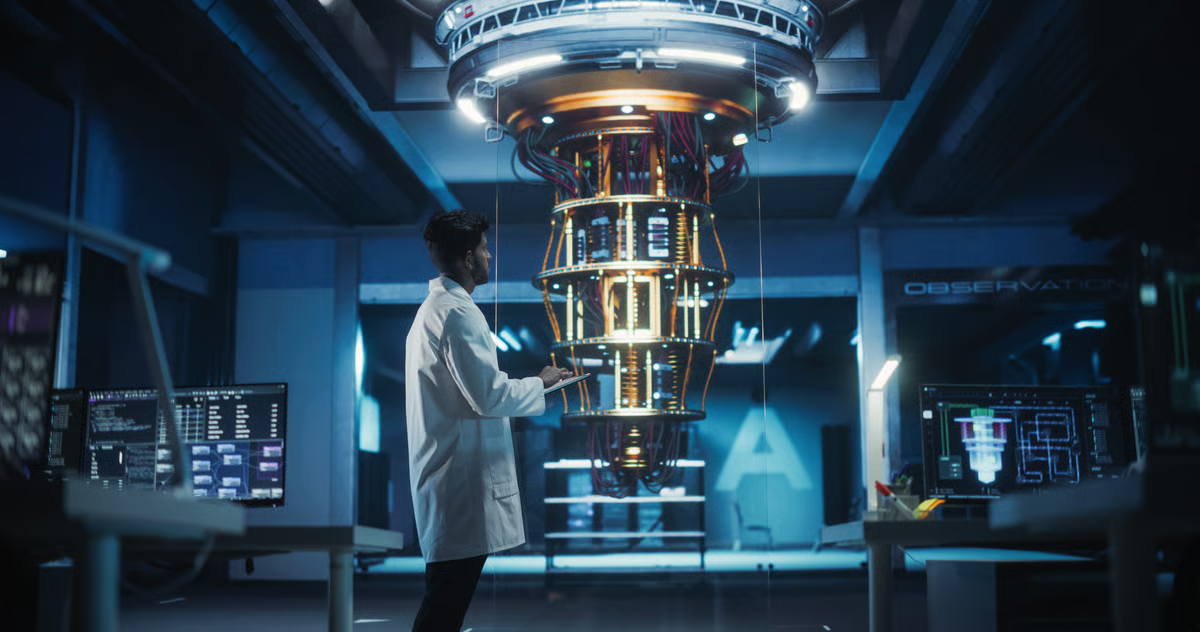
Just days after the announcement of a $2 billion funding injection for the quantum computing industry from the U.S. Department of Commerce, including plans for $100 million to go toward D-Wave's continued development of its two-pronged technological approach, the company revealed another bit of support from the government.
DoC's proposed $2.013B quantum funding sparks a sector rally, putting D-Wave Quantum and Honeywell's Quantinuum among key beneficiaries.

D-Wave Quantum Inc. (NYSE:QBTS) is hosting its first-ever Investor Day Monday against a politically charged backdrop: just 11 days ago, the Trump administration signed a Letter of Intent to invest $100 million in the company under the CHIPS Act — with the Department of Commerce set to receive an equity stake as a condition of the funding.

PALO ALTO, Calif.--(BUSINESS WIRE)--D-Wave Quantum Inc. (NYSE: QBTS), (“D-Wave” or the “Company”), the only dual-platform quantum computing company providing both annealing and gate-model systems, software and services, today announced a new gate-model roadmap designed to accelerate the development of commercial, fault-tolerant quantum computing. Targeting 100 logical qubits capable of successfully performing over one million operations by 2032, the roadmap combines D-Wave's expertise in high-c.

The government can handle more risk than you might be comfortable with.

QBTS gains momentum after a proposed $100M CHIPS Act award, with growing commercial adoption and higher analyst-implied upside than RGTI.

Today, May 28, 2026, investors weigh recent U.S. quantum funding and long-term sector hopes for this fast-rising name.

The individuals who know the stock market's scorching-hot quantum computing stocks best are telling a worrisome tale.

QBTS may offer stronger June upside than IONQ as bookings surge, enterprise adoption rises and analyst price targets imply bigger gains.

The government will invest up to $100 million each in D-Wave, Rigetti, and Infleqtion.

While the U.S. government's recent $2 billion capital injection via the CHIPS and Science Act provides a significant operational runway, the more profound structural shift is happening at the commercial level. The industry has finally crossed the chasm from theoretical lab physics to utility-scale industrial infrastructure, driven by a rapid acceleration in enterprise bookings, the maturation of recurring cloud-based revenue models, and a structural pivot toward high-yield commercial wafer fabrication.
Explore how two quantum innovators stack up on customer reach, financial health, and risk as they race for commercial leadership in a fast-evolving sector.
Quantum computing stocks surged last week after the U.S. Department of Commerce announced $2.013 billion in CHIPS and Science Act grants to nine quantum computing companies, marking one of the largest federal commitments ever made to the sector.

Today, May 26, 2026, investors balance new federal quantum backing against valuation risks and a new challenge to quantum superiority.

D-Wave's impressive valuation rally is taking a breather.

The Commerce Department signed letters of intent to provide about $2 billion in CHIPS Act funding to nine quantum companies, taking a minority equity stake in each. IBM is in line for the biggest share -- $1 billion toward a new U.S. quantum chip foundry -- and its stock jumped double digits.
QBTS gains traction with record bookings and expanding system sales, while Rigetti Computing bets on long-term gate-model breakthroughs.

PALO ALTO, Calif.--(BUSINESS WIRE)--D-Wave Quantum Inc. (NYSE: QBTS), (“D-Wave” or the “Company”), the only dual-platform quantum computing company providing both annealing and gate-model systems, software and services, today issued the following response to recent claims that newly published classical simulation work has “overturned” D-Wave's demonstration of quantum computational supremacy in quantum simulation. The claim that D-Wave's achievement has been overturned is inaccurate and not sup.

May 2026 has been a rollercoaster month for companies in the quantum computing industry, as leaders like D-Wave Quantum Inc. NYSE: QBTS, IonQ Inc. NYSE: IONQ, and Rigetti Computing NASDAQ: RGTI fell for much of the month, despite some promising Q1 results, before surging sharply toward month-end.

The IPO market is waking up again, and few offerings have generated as much buzz as SpaceX.
PALO ALTO, Calif.--(BUSINESS WIRE)--D-Wave Quantum Inc. (NYSE: QBTS), the only dual-platform quantum computing company providing both annealing and gate-model systems, software and services, today announced that it has been awarded second year funding for the Improved Materials for Superconducting Qubits with Scalable Fabrication (SQFab) project by the Northeast Regional Defense Technology Hub (NORDTECH). Awarded to D-Wave subsidiary Quantum Circuits, LLC, the SQFab project is one of four innov.

QBTS soars 62% after Q1 as record bookings, a growing backlog and expanding AI and blockchain use cases boosted investor optimism.
D-Wave Quantum's products are becoming more popular.

The U.S. plans to invest $2 billion in nine quantum computing companies. That spending could drive more retail and institutional investors to the niche market.

A $100 million grant will help pave the way for commercialization of D-Wave's gate-model quantum systems.
TD Cowen thinks D-Wave will be one of the biggest winners from the U.S. government's investments in quantum computing. The U.S. Department of Commerce is on track to invest $100 million in D-Wave.

The U.S. Department of Commerce award $2 billion in grants to quantum computing companies. It will award $0 of grants to Quantum Computing Inc.
Shares of Rigetti Computing (NASDAQ:RGTI), Quantum Computing Inc.

D-Wave stock surged today following news that the company is on track to receive CHIPS Act funding. D-Wave is set to receive $100 million for the sale of new stock to the U.S. Department of Commerce.

Record Q1 revenue, raised 2026 guidance, and the pending SkyWater acquisition give IonQ company-specific markers to watch as federal funding headlines draw attention back to quantum computing.

CNBC's Kelly Evans talks with D-Wave Quantum CEO Alan Baratz about the expected $100 million U.S. investment in the company to advance quantum computing and more.

Artificial intelligence (AI) might be the talk of the town these days, but quantum computing is the quiet thunder rumbling in the background. It just got much louder with the U.S. White House commiting to roll out a massive $2 billion funding package distributed across nine quantum computing companies.

The federal government is moving to expand its investment portfolio with stakes in a number of quantum computing firms, sending their shares higher Thursday.
Two earnings reports are pulling the market in opposite directions today. Quantum computing stole the show anyway.
It's a good day to be an American quantum computing company—well, as long as you're willing to give up some equity.

The Trump Administration plans to award $2 billion in grants and take equity stakes in nine quantum computing companies. Despite having the best name in the industry, Quantum Computing stock is not one of them.
The U.S. government just dissed IonQ by awarding grants to everyone else, who's anyone else, in quantum computing.

Quantum computing stocks climbed Thursday after the Trump administration reportedly moved to award $2 billion to nine companies in the sector, while taking a piece for themselves.

Quantum computing stocks are shrugging of Nvidia (NVDA) and tech weakness today.

IonQ‘s (NYSE:IONQ | IONQ Price Prediction) shares are up 10% in early Thursday trading, while D-Wave Quantum (NYSE:QBTS) stock is spiking 25% higher.

IONQ's Q1 2026 shows platform pull-through: 60% commercial, 35% international and raised 2026 revenue outlook to $260-$270 million.

PALO ALTO, Calif.--(BUSINESS WIRE)--D-Wave Quantum Inc. (NYSE: QBTS), (“D-Wave” or the “Company”), the only dual-platform quantum computing company providing both annealing and gate-model systems, software and services, today announced that it has signed a Letter of Intent (LOI) for $100 million of proposed funding under the U.S. CHIPS and Science Act, which is administered by the U.S. Department of Commerce. In connection with executing final award documents, D-Wave would issue $100 million in.

D-Wave Quantum Inc. is approaching a commercialization inflection point, with bookings surging and investor day on June 1 as a key catalyst. QBTS reported Q1 bookings of $33.4 million, up sharply year-over-year, and now expects 2–3 system sales per year, signaling early market traction. Despite a near-90% year-over-year revenue decline, robust bookings and a strong sales pipeline support a bullish outlook after a prolonged pullback.

QBTS and RGTI are gaining momentum in May 2026 as analysts see more than 90% upside tied to quantum adoption and commercial traction.

D-Wave Quantum grew revenue by 179% last year and just hit a quarterly bookings record. However, it still isn't making much money, especially compared to rival IonQ.
IonQ (NYSE:IONQ | IONQ Price Prediction) shares are down roughly 7%, D-Wave Quantum (NYSE:QBTS) stock is off 8%, and shares of Rigetti Computing (NASDAQ:RGTI) and Quantum Computing (NASDAQ:QUBT) are dropping 10%.

Quantinuum filed its S-1 with the Securities and Exchange Commission (SEC) earlier this month.

D-Wave Quantum stock has gained 93% over the last year.

This technology isn't ready to go mainstream yet, but getting portfolio exposure to it before that happens could prove a profitable strategy.
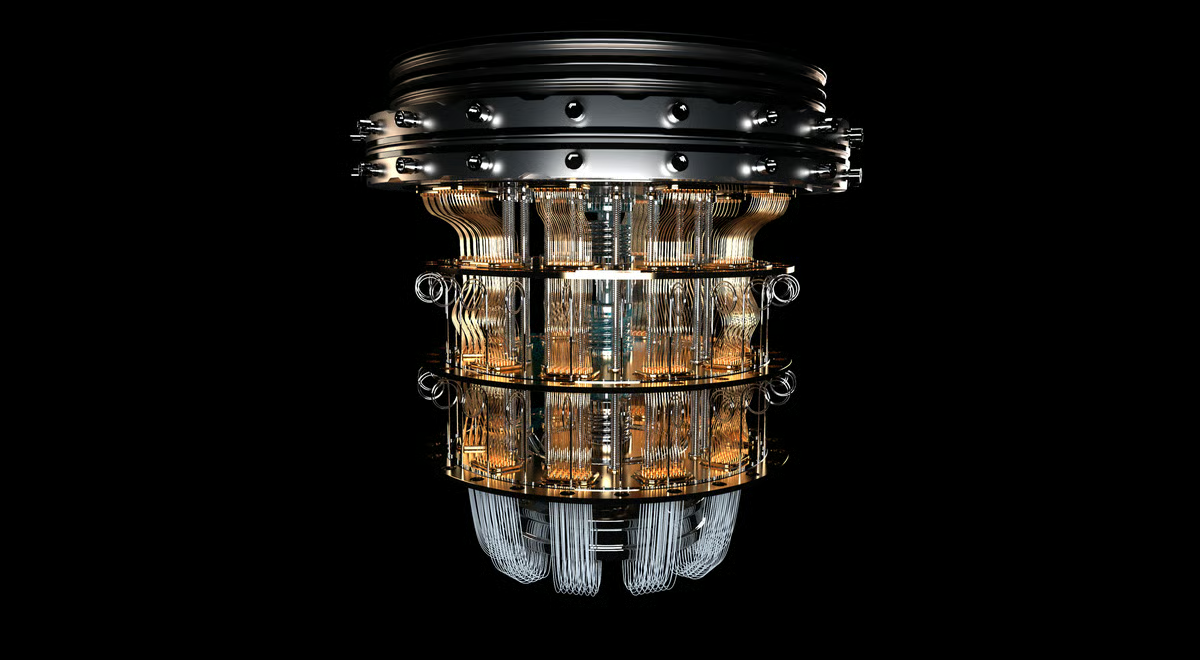
D-Wave bookings surged 1,994% YoY to $33.4 million, while remaining performance obligations expanded 563% to $42.4 million. The company generated 82.59% gross margins, supporting a potentially scalable recurring quantum-computing-as-a-service revenue model. Q1 revenue collapsed 81% YoY to $2.9 million after missing a large hardware transaction recorded during prior-year results.