Loading market dashboard

Range Nuclear Renaissance Index ETF
NUKZFinancial ServicesAMEXUS
Loading disclosure news
News and disclosures filtered by period, publisher, and event group.
Select a headline to open the full news page in the app.
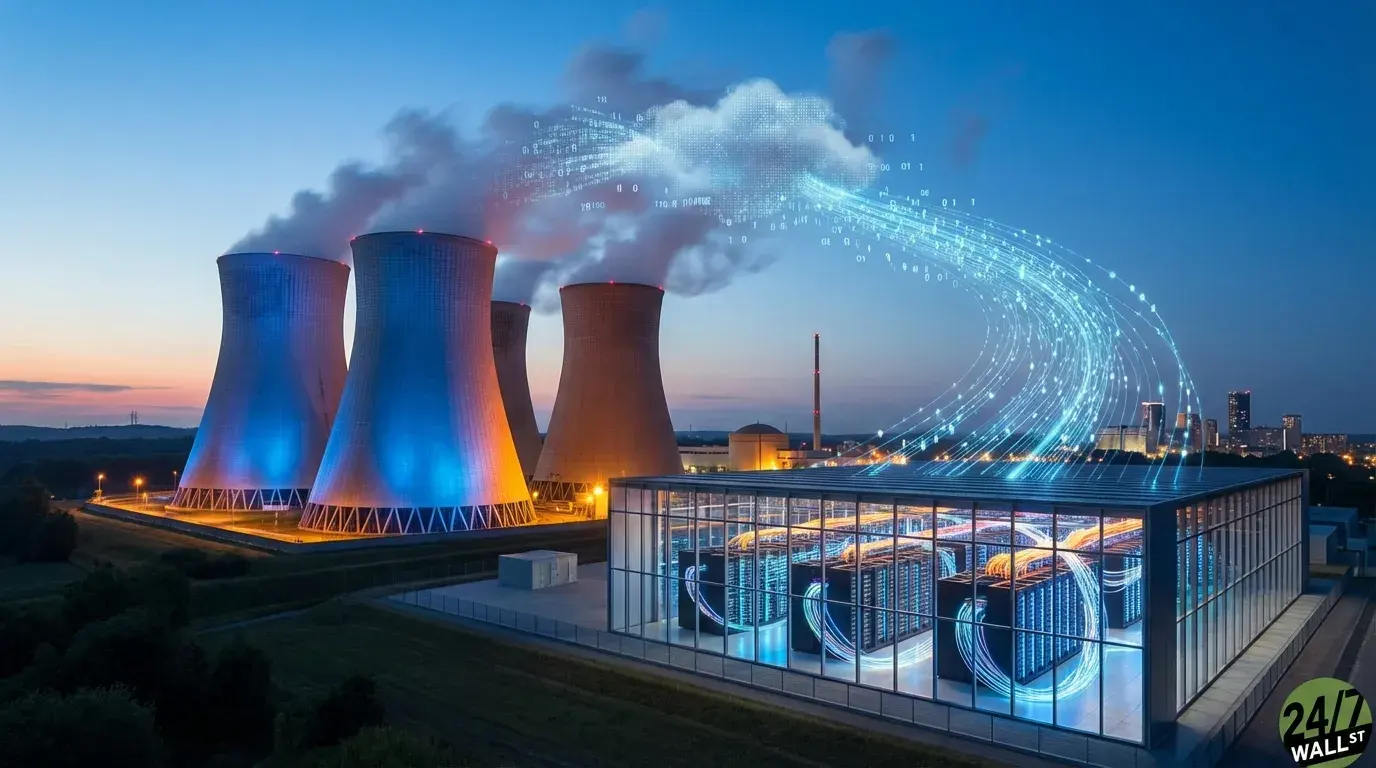
Nuclear power has become the default answer to a question Wall Street did not expect to ask this decade: where will the electricity for AI come from?

For years, governments and industry have discussed the energy trilemma, which is the need for secure, affordable, and low-carbon energy. Following the Paris Climate Accord in 2015, significant emphasis was placed on the low-carbon component as countries and corporations set net-zero emission targets.
The nuclear sector is capturing significant investor attention, as federal policy continues to align with grid modernization efforts. The U.S. Department of Energy (DOE) recently announced $94 million in Federal cost-shared funding to expedite the deployment of advanced small modular reactors (SMRs).

The hyperscalers have a math problem. US power generation from data centers is projected to climb from about 5% of the total to roughly 15% over a five-year span, a step change on a grid that has barely grown since 2000.

The narrative was irresistible. AI data centers need power, nuclear is the answer, and the Range Nuclear Renaissance Index ETF (NASDAQ: NUKZ) wears the trade right on the label. Launched in 2024, NUKZ has delivered, riding the restart story to a one-year gain of 53%. The question is whether NUKZ deserves a spot in your portfolio... NUKZ Caught the Nuclear Restart Wave But Holds Less Than $1 Billion in Assets, And That Liquidity Cliff Matters
AI-driven data center power demand is reviving nuclear energy, lifting ETFs tied to uranium miners as well as nuclear power generators.

The investment narrative surrounding nuclear energy has shifted dramatically, from a traditional defensive utility play to a high-growth thematic opportunity. While global decarbonization goals and energy security initially catalyzed this shift, the massive power requirements of AI data centers have rapidly accelerated the build-out.

Cameco (CCJ) provided a robust outlook for the deployment of Westinghouse's AP1000 reactor technology on its first quarter 2026 earnings call earlier this month. Company leadership now sees a realistic near-term path to as many as 20 of the large-scale reactor units entering construction in the United States.

I reiterate a buy rating on the Range Nuclear Renaissance ETF, citing compelling growth-adjusted valuation and favorable long-term demand drivers. NUKZ trades at a 20.6x P/E with a 16% long-term earnings growth rate, yielding a PEG ratio of 1.25x. Technical setup shows an ascending triangle with support in the mid-$60s and a measured move upside target of $90.

The nuclear energy sector reached a pivotal milestone this month as Ontario Power Generation (OPG) successfully installed the first basemat module for the Darlington New Nuclear Project. This development marks a significant leap forward for the G7's first commercial grid-scale Small Modular Reactor (SMR), signaling a tangible shift in the nuclear renaissance for global investors.
The nuclear industry has seen a recent flurry of announcements, headlined by two major industry partnerships to rapidly deploy new reactors. These exciting developments come against the backdrop of a new national poll showing increased positive sentiment towards nuclear energy.

The Department of Energy (DOE) recently unveiled further details for its Defense Production Act (DPA) Consortium. This marks a significant milestone in the effort to secure a reliable nuclear fuel supply chain.

Hyperscalers building out AI infrastructure have run into a hard constraint: electricity.

Volatility has defined energy markets throughout 2026, as oil prices and equities respond to geopolitical turmoil and shifting global supply expectations. While the year began with a bearish consensus forecast for oil prices in the high $50s, escalating tensions in the Middle East have pushed crude significantly higher.
X-energy (XE), the developer of the Xe-100 advanced small modular reactor (SMR) and XENITH microreactor, made its public market debut earlier this month. The company executed an upsized initial public offering that raised more than $1 billion.
Oil shock, AI power demand and energy security fears are driving a nuclear comeback. ETFs like NLR and NUKZ stand to benefit.
AI continues to be the hottest investing theme on Wall Street, but the narrative is shifting. The last two years were defined by the “silicon rush,” but 2026 has revealed the AI revolution is increasingly becoming more of an energy and power story than a hardware story.
The U.S. Navy's FY2027 shipbuilding request, released earlier this month, calls for $65.8 billion in funding, marking the highest single-year shipbuilding ask in decades. Over one-third of that total, or more than $25 billion, targets nuclear-powered platforms.

The state-led push to revitalize the U.S. nuclear sector underscores the significant shift in the domestic energy landscape. The nuclear energy narrative is rapidly changing.
During the VettaFi Asset Allocation Summit in April, advisors told VettaFi about their strong interest in thematic ETFs. More than a third (35%) of attendee respondents said they expect to add to thematic ETFs in the next three months.

Stacey Morris, head of energy research at VettaFi, joined Nate Geraci on this week's ETF Prime to discuss energy ETFs amid the Iran conflict. Geopolitics currently dominates oil prices and energy stocks, though the sector posted strong gains before the war began, according to Morris.

Top articles during the week of April 12 ran the gamut in terms of subject matter, but mainly dug into the inner workings of key ETFs.

Engineering, procurement, and construction (EPC) firms are expected to play a significant role in the nuclear renaissance. Accordingly, this would present a compelling opportunity for investors.

While some investment themes have struggled to maintain their trajectory, the space economy has proven it has the fundamental fuel to reach escape velocity. This momentum is being met with a strategic modernization of the underlying infrastructure for UFO.

The Nuclear Regulatory Commission's (NRC) arduous licensing process remains the most frequently cited barrier to rapidly iterating and deploying nuclear energy in the United States. Traditional frameworks — built around large, light-water reactor designs — have required newer technologies to undergo lengthy reviews and seek extensive exemptions.

While geopolitical headlines often focus on short-term volatility in the Middle East, the long-term investment case for energy remains centered on security, reliability, and North American export dominance. Stacey Morris, CFA, head of energy research at VettaFi, recently highlighted some long-term views on energy investing beyond the current oil price spike.

One critical step of the nuclear fuel chain, uranium enrichment, has long been a domestic vulnerability for the United States. Traditional gas-centrifuge technology has been the proven workhorse for decades, delivering low-enriched uranium (LEU) for today's reactor fleet.

One critical step of the nuclear fuel chain, uranium enrichment, has long been a domestic vulnerability for the United States. Traditional gas-centrifuge technology has been the proven workhorse for decades, delivering low-enriched uranium (LEU) for today's reactor fleet.
For years, the narrative surrounding the nuclear energy sector was one of managed decline, with regulatory filings dominated by decommissioning schedules and site closures. However, a recent wave of global permit approvals and construction applications prove a fundamental shift is underway.
The debate over whether artificial intelligence has entered bubble territory has reached a fever pitch. For this edition of Bull vs Bear, writers Nicholas Peters-Golden and DJ Shaw discuss the disconnect between infrastructure spending and software revenue.

The domestic nuclear energy landscape is undergoing a fundamental shift from preservation to expansion. Recent announcements from the Department of Energy (DOE) have signaled a significant federal commitment to both the existing nuclear reactor fleet and the infrastructure required to support it.
New York, New York and London, United Kingdom--(Newsfile Corp. - April 8, 2026) - VettaFi, a differentiated index provider with

Investors have taken notice of the eye-popping federal commitments to new nuclear capacity in the U.S. in recent months. Headlines have focused on massive reactor-deployment partnerships and loan authority in the hundreds of billions.
The market is currently focused on the immediate power needs of AI and data centers. However, a more profound global nuclear renaissance is unfolding, centered on a massive overhaul of the global power infrastructure.

The federal government has been very focused on supporting nuclear development in the U.S. Within that framework, states are currently vying to host Nuclear Lifecycle Innovation Campuses (NLIC) and boost their economies.
For nearly two decades, the playbook for U.S. tech investors focused almost exclusively on software scalability. However, as artificial intelligence transitions from digital experimentation to industrial implementation, the conversation has shifted toward the physical constraints of the revolution.

The U.S. Energy Information Administration projected in March 2026 that American power demand will climb to a new record in 2026 and keep rising through 2027, driven largely by AI data centers. Nuclear is one of the few energy sources positioned to absorb that load reliably, and its share of the generation mix is forecast... The Nuclear ETFs Powering AI Data Centers and Posting Triple-Digit Returns.
As the U.S.-Israeli conflict with Iran continues, global energy markets are feeling the strain. The effective closing of the Strait of Hormuz, which is the chokepoint for roughly 20% of the world's petroleum and liquefied natural gas (LNG) trade, combined with attacks on energy infrastructure have driven sharp spikes in commodity prices.

The nuclear energy sector reached a pivotal regulatory milestone last week. The results could redefine the timeline for advanced reactor deployment in the U.S. The U.S. Nuclear Regulatory Commission (NRC) voted on March 4 to issue a construction permit to TerraPower for its Natrium advanced reactor project in Kemmerer, Wyoming.

The nuclear renaissance represents an exciting opportunity for investors to allocate their capital to some of the most technologically advanced methods of electricity production. Common questions come to mind.