Loading market dashboard

iShares National Muni Bond ETF
MUBFinancial ServicesAMEXUS
Loading disclosure news
News and disclosures filtered by period, publisher, and event group.
Select a headline to open the full news page in the app.
The artificial intelligence boom has spent three years as a stock market story. This year it became a bond market problem.

A married couple filing jointly with $400,000 of taxable income occupies one of the highest tax brackets many affluent retirees and professionals will encounter before reaching the top tier. At that income level, federal taxes already take a meaningful bite out of interest income, and investors in high-tax states can face an even steeper combined burden.... This $750,000 Municipal Bond Sleeve Pays a High-Earner Couple $33,000 a Year of Federal-Tax-Free Income

The mechanics of retirement income are often simpler than the investment products marketed to provide it. A 72-year-old retiree with $1.1 million invested and an income goal of $52,800 per year, or $4,400 per month, needs a portfolio yield of roughly 4.8%. Everything else, from security selection and account placement to rebalancing decisions, revolves around... A 4.8 Percent Yield Portfolio That Lets a 72-Year-Old Sleep Through Every Quarterly Earnings Surprise

The 10-year Treasury yields 4.43%, which sounds competitive until a high earner runs it through the tax screen.

The Bank of Japan should provide a clear roadmap for policy normalisation following an anticipated interest rate increase in June to help stabilise the government bond market, according to Arihiro Nagata, global markets chief at Sumitomo Mitsui Financial Group. Speaking to Reuters, Nagata said he expects the BOJ to raise interest rates at its June 15-16 policy meeting and stressed that the central bank's communication regarding future policy moves will be closely watched by financial markets.

The price data already shows the pressure building. WTI crude closed at $112.25 per barrel on May 18, 2026, up 30.7% over the prior month and sitting at the 98.4th percentile of its 12-month range.

A blended 5.8% yield on a $1 million portfolio generates roughly $58,000 in annual income, enough to cover a significant portion of basic retirement expenses before Social Security enters the picture. But the more important question is not just how much income the portfolio produces. It is how that income is taxed. Two retirees receiving... A Million Dollar Dividend Portfolio Engineered to Pay $58,000 a Year in Mostly Tax Advantaged Income

@CharlesSchwab's Collin Martin breaks down the state of treasury yields and the U.S.-Iran War's impact on them. He says for the most part, stagflation doesn't appear to a huge issue for the economy even though all eyes are on the inflationary front given the rising cost of oil and gas.

A carousel of leaders has taken its toll, driving up borrowing costs and dragging down investment.

Gold drops as rates rise on Thursday, as we continue to see higher yields work against the value of gold. At this point, we are seeing a lot of overhead pressures, but still have a longer-term bullish run possible.

For decades, the playbook for high-income investors was almost reflexive: put municipal bonds in your taxable account, put Treasuries and corporates in your IRA.

A $75,000 salary sits at the top of the U.S. median household range, but for a retiree in a high federal and state bracket, replacing it with taxable income means earning much more before Uncle Sam takes his cut.

CPI Inflation recently accelerated to a three-year high due to elevated energy prices tied to the U.S-Iran conflict. Treasury bond yields have risen sharply due to expectations that the Federal Reserve will pivot to interest rate hikes.

Kevin Warsh was sworn in as Federal Reserve Chairman this week, and the most striking thing about his arrival is how little Wall Street seems to care.

Joumanna Bercetche, Tom Mackenzie and Ven Ram break down today's key themes for analysts and investors on "Bloomberg: The Opening Trade." Chapters: 00:00:00 - MLIV 00:00:03 - Potential Iran Deal, JGBs 00:01:17 - Bond Market Selloff 00:01:54 - USD-Japanese Yen -------- More on Bloomberg Television and Markets Like this video?

Reid L'anson breaks down how the war in Iran is impacting the energy market. He says coming into the year thinking we'd be short on oil helped coming into geopolitical conflict, but every day the Strait of Hormuz stays closed we lose profit.
Bloomberg's Aashah Shah joins Scarlet Fu on "Bloomberg Real Yield." May has been a strong month for muni bond issuance, with about $35 billion of sales so far this year.
High-bracket retirees face a math problem that taxable bond funds cannot solve: every dollar of interest income gets taxed at the federal marginal rate, often layered with a state tax bite.
The usual advice is to hold only 60% of your assets in stock. If you're wealthy, a 90/10 split is far better.

For most of the past two years, investors have focused on the stock market's resilience.

The 10-year Treasury yield is now close to 4.7%, threatening higher borrowing costs.

Income-focused investors are in a real dilemma as government bond yields surge amid the rising inflation rate in the United States. Do they invest in the blue-chip Schwab US Dividend Equity ETF (SCHD) or invest in the higher-yielding JPMorgan Premium Income ETF (JEPI).

Expense ratios, tax treatment, and risk profiles set these two bond ETFs apart. See how their distinct approaches may influence fixed-income strategies.
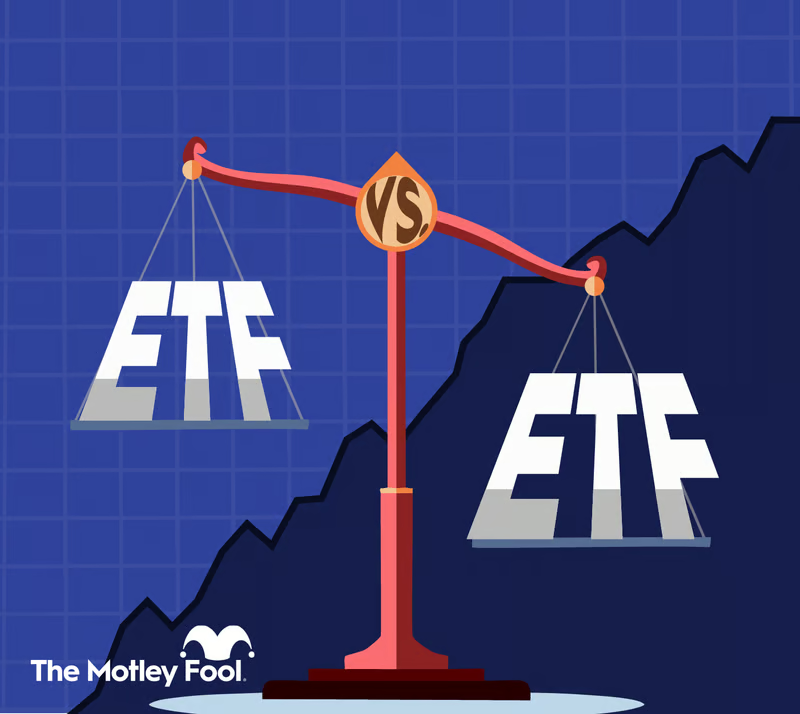
Anna Edwards, Guy Johnson, Tom Mackenzie and Mark Cudmore break down today's key themes for analysts and investors on "Bloomberg: The Opening Trade." Chapters: 00:00:00 - MLIV 00:00:01 - Japanese Bonds, US Treasuries 00:01:30 - Stock Performance if Yields Increase 00:02:40 - Buy the Dip in Semiconductor Stocks?

The amount of inflation priced into 10-year Treasury yields is a little hard to square with what the market is saying about price rises in the near term. Either inflation is going to be high for a long time, and this is something that has changed in the past week or two, or 10-year yields have gone a little too far.

Bonds are buckling around the world, propelling borrowing costs to multi-year highs. Ruth Carson explains why.

A new concentration risk is building inside the corporate bond market, and it mirrors what investors are already experiencing with the Magnificent Seven in the S&P 500 index.
Bitcoin's ( CRYPTO: BTC ) latest rally attempt is running into an unexpected wall; the U.S.

Longer-dated Treasury yields climbed to their highest levels since May 2025 on Friday, as a spike in oil prices stoked fears that ongoing energy disruptions in the Middle East could further fuel inflation — which data this week showed had already surged in April.

Back-to-back inflation reports out of the US along with heightened energy prices and mounting political uncertainty have seen investors flee global bond markets as benchmark interest rates to the highest levels in nearly a year. The Opening Trade spoke with leading market voices and economists for their analysis.

Every investor eventually faces the same question: when does the certainty of a bond beat the upside of a stock?

Muni bond ETFs may shine in 2026 as attractive yields, solid credit quality and easing policy risks boost investor appeal.

March's bout of geopolitical volatility affected investment approaches of all kinds, and municipal bonds were unfortunately no different. As just one example, the Bloomberg Municipal Bond Index fell more than 2% on the month, as the fixed income asset struggled to retain its safe haven reputation.

Key Takeaways The April FOMC meeting's four dissents and resistance to maintaining an easing bias signal a higher bar for rate cuts under incoming Chair Warsh, suggesting investors may favor Treasury floating-rate strategies to navigate a prolonged “higher-for-longer” environment.

AI-driven electricity demand is forcing a decade of infrastructure spending into five years. The municipal bond market is becoming a primary financing channel for that buildout, creating income opportunity.

It's not just inflation concerns that have been pushing U.K. yields to multi-decade highs

SUMMARY “Yield Matters” but investors cannot ignore real yields. Real yields are attractive near 2% despite rising inflation, in our opinion.
Your retirement check is about to get squeezed by a Fed civil war you did not vote for.

With the Justice Department dropping its investigation into the Fed's building renovation, political uncertainty around the succession has faded, paving the way for Kevin Warsh's nomination as the next Fed chair. Warsh's recent remarks lay out how he views monetary policy and the implications for the bond market during his tenure.

For investors in higher federal tax brackets, the headline yield on a municipal bond fund understates the real value of the income.

Investors may be better off looking outside the world's core bond markets right now, Brij Khurana writes in a guest commentary.

Comerica Bank increased its stake in iShares National Muni Bond ETF (NYSEARCA:MUB) by 2.1% during the fourth quarter, according to its most recent filing with the Securities and Exchange Commission. The fund owned 407,499 shares of the exchange traded fund's stock after acquiring an additional 8,216 shares during the quarter. Comerica Bank

Calamos Wealth Management LLC increased its stake in shares of iShares National Muni Bond ETF (NYSEARCA:MUB) by 242.7% in the fourth quarter, according to the company in its most recent Form 13F filing with the SEC. The fund owned 18,394 shares of the exchange traded fund's stock after acquiring an additional 13,027

Confluence Wealth Services Inc. grew its position in iShares National Muni Bond ETF (NYSEARCA:MUB) by 10.8% during the fourth quarter, according to the company in its most recent disclosure with the Securities and Exchange Commission. The firm owned 91,906 shares of the exchange traded fund's stock after purchasing an additional 8,984 shares

A $1 million municipal bond portfolio yielding 5% generates $50,000 per year in interest income that the federal government cannot touch. For a married couple in the top tax bracket, that same $50,000 would require roughly $79,365 in taxable bond income to produce the same after-tax result. Municipal bonds are issued by states, cities, school... $1 Million in Municipal Bonds Generates $50,000 Tax-Free Income That Beats Treasury Returns

A physician in California earning $500,000 a year hands roughly half of every dollar of taxable investment income to the government. That math is quietly pushing high-earning professionals toward municipal bonds right now, and the window for this trade is as wide as it has been in over a decade. The Tax Problem High Earners... Why Doctors and Lawyers in High-Tax States Are Moving Money Into Muni Bonds as Rates Rise

Cardinal Strategic Wealth Guidance lowered its stake in iShares National Muni Bond ETF (NYSEARCA:MUB) by 12.7% during the fourth quarter, according to its most recent 13F filing with the Securities and Exchange Commission (SEC). The institutional investor owned 182,339 shares of the exchange traded fund's stock after selling 26,567 shares during the

A 30-year AA-rated municipal bond currently yields 4.75%, and that number looks modest next to a 7% corporate bond. But for a high earner in the top federal bracket, the muni wins by a wide margin after taxes. The math is the entire story here, and it is one of the most consistently underused tools... The Income Strategy That Pays High Earners More After Tax Than a 7% Taxable Bond
Guidance Capital Inc. cut its stake in iShares National Muni Bond ETF (NYSEARCA:MUB) by 48.5% in the fourth quarter, according to the company in its most recent filing with the Securities and Exchange Commission (SEC). The fund owned 10,847 shares of the exchange traded fund's stock after selling 10,233 shares during the

Farther Finance Advisors LLC raised its holdings in iShares National Muni Bond ETF (NYSEARCA:MUB) by 4.9% in the fourth quarter, according to its most recent 13F filing with the Securities and Exchange Commission. The fund owned 476,523 shares of the exchange traded fund's stock after acquiring an additional 22,475 shares during the

BSW Wealth Partners grew its position in shares of iShares National Muni Bond ETF (NYSEARCA:MUB) by 43.8% during the undefined quarter, according to the company in its most recent filing with the SEC. The firm owned 99,354 shares of the exchange traded fund's stock after purchasing an additional 30,239 shares during the

For financial advisors, tax season should not be the only time to talk to clients about municipal bonds. However, with April 15 arriving this week, the timing is ideal to examine how muni bond ETFs are rapidly becoming a cornerstone of fixed-income allocations in 2026.

IEI carries a higher expense ratio and a slightly higher yield than MUB. MUB outperformed IEI over the past year and five-year period, but IEI holds up well in risk-adjusted terms.

Granite Harbor Advisors Inc. trimmed its position in iShares National Muni Bond ETF (NYSEARCA:MUB) by 41.5% in the fourth quarter, according to its most recent filing with the SEC. The institutional investor owned 54,690 shares of the exchange traded fund's stock after selling 38,818 shares during the period. iShares National Muni Bond

Bear Mountain Capital Inc. decreased its position in iShares National Muni Bond ETF (NYSEARCA:MUB) by 10.4% during the fourth quarter, according to its most recent disclosure with the Securities and Exchange Commission. The firm owned 223,423 shares of the exchange traded fund's stock after selling 25,832 shares during the quarter. iShares National

Asio Capital LLC reduced its stake in shares of iShares National Muni Bond ETF (NYSEARCA:MUB) by 18.4% in the fourth quarter, according to its most recent filing with the Securities and Exchange Commission. The firm owned 63,224 shares of the exchange traded fund's stock after selling 14,261 shares during the period. Asio

Apella Capital LLC raised its position in iShares National Muni Bond ETF (NYSEARCA:MUB) by 7.3% in the undefined quarter, according to the company in its most recent filing with the Securities and Exchange Commission (SEC). The firm owned 181,727 shares of the exchange traded fund's stock after purchasing an additional 12,375 shares

Revolve Wealth Partners LLC grew its position in shares of iShares National Muni Bond ETF (NYSEARCA:MUB) by 4.6% in the fourth quarter, according to its most recent filing with the SEC. The fund owned 148,750 shares of the exchange traded fund's stock after acquiring an additional 6,555 shares during the quarter. iShares

Savvy Advisors Inc. lifted its stake in iShares National Muni Bond ETF (NYSEARCA:MUB) by 37.0% during the fourth quarter, according to the company in its most recent 13F filing with the Securities and Exchange Commission. The institutional investor owned 272,482 shares of the exchange traded fund's stock after purchasing an additional 73,519

Chatterton and Associates Inc. acquired a new position in shares of iShares National Muni Bond ETF (NYSEARCA:MUB) during the fourth quarter, according to the company in its most recent Form 13F filing with the Securities and Exchange Commission. The fund acquired 15,323 shares of the exchange traded fund's stock, valued at approximately