Loading market dashboard

iShares 5-10 Year Investment Grade Corporate Bond ETF
IGIBFinancial ServicesNASDAQUS
Loading disclosure news
News and disclosures filtered by period, publisher, and event group.
Select a headline to open the full news page in the app.
The artificial intelligence boom has spent three years as a stock market story. This year it became a bond market problem.
Compare diversification and risk profiles as these two bond ETFs take different approaches to balancing income and safety for your portfolio.
The Bank of Japan should provide a clear roadmap for policy normalisation following an anticipated interest rate increase in June to help stabilise the government bond market, according to Arihiro Nagata, global markets chief at Sumitomo Mitsui Financial Group. Speaking to Reuters, Nagata said he expects the BOJ to raise interest rates at its June 15-16 policy meeting and stressed that the central bank's communication regarding future policy moves will be closely watched by financial markets.

The price data already shows the pressure building. WTI crude closed at $112.25 per barrel on May 18, 2026, up 30.7% over the prior month and sitting at the 98.4th percentile of its 12-month range.

@CharlesSchwab's Collin Martin breaks down the state of treasury yields and the U.S.-Iran War's impact on them. He says for the most part, stagflation doesn't appear to a huge issue for the economy even though all eyes are on the inflationary front given the rising cost of oil and gas.

A carousel of leaders has taken its toll, driving up borrowing costs and dragging down investment.

Both funds delivered nearly identical returns and yields last year.
Highly rated debts offer high yields but are priced close to perfection.
CPI Inflation recently accelerated to a three-year high due to elevated energy prices tied to the U.S-Iran conflict. Treasury bond yields have risen sharply due to expectations that the Federal Reserve will pivot to interest rate hikes.

Kevin Warsh was sworn in as Federal Reserve Chairman this week, and the most striking thing about his arrival is how little Wall Street seems to care.
Joumanna Bercetche, Tom Mackenzie and Ven Ram break down today's key themes for analysts and investors on "Bloomberg: The Opening Trade." Chapters: 00:00:00 - MLIV 00:00:03 - Potential Iran Deal, JGBs 00:01:17 - Bond Market Selloff 00:01:54 - USD-Japanese Yen -------- More on Bloomberg Television and Markets Like this video?
The usual advice is to hold only 60% of your assets in stock. If you're wealthy, a 90/10 split is far better.

For most of the past two years, investors have focused on the stock market's resilience.
The 10-year Treasury yield is now close to 4.7%, threatening higher borrowing costs.

Anna Edwards, Guy Johnson, Tom Mackenzie and Mark Cudmore break down today's key themes for analysts and investors on "Bloomberg: The Opening Trade." Chapters: 00:00:00 - MLIV 00:00:01 - Japanese Bonds, US Treasuries 00:01:30 - Stock Performance if Yields Increase 00:02:40 - Buy the Dip in Semiconductor Stocks?

The amount of inflation priced into 10-year Treasury yields is a little hard to square with what the market is saying about price rises in the near term. Either inflation is going to be high for a long time, and this is something that has changed in the past week or two, or 10-year yields have gone a little too far.

Bonds are buckling around the world, propelling borrowing costs to multi-year highs. Ruth Carson explains why.
Longer-dated Treasury yields climbed to their highest levels since May 2025 on Friday, as a spike in oil prices stoked fears that ongoing energy disruptions in the Middle East could further fuel inflation — which data this week showed had already surged in April.

Every investor eventually faces the same question: when does the certainty of a bond beat the upside of a stock?

Key Takeaways The April FOMC meeting's four dissents and resistance to maintaining an easing bias signal a higher bar for rate cuts under incoming Chair Warsh, suggesting investors may favor Treasury floating-rate strategies to navigate a prolonged “higher-for-longer” environment.
AI-driven electricity demand is forcing a decade of infrastructure spending into five years. The municipal bond market is becoming a primary financing channel for that buildout, creating income opportunity.

It's not just inflation concerns that have been pushing U.K. yields to multi-decade highs

With the Justice Department dropping its investigation into the Fed's building renovation, political uncertainty around the succession has faded, paving the way for Kevin Warsh's nomination as the next Fed chair. Warsh's recent remarks lay out how he views monetary policy and the implications for the bond market during his tenure.
Investors may be better off looking outside the world's core bond markets right now, Brij Khurana writes in a guest commentary.

IGIB carries a much lower expense ratio and a higher dividend yield than IEI IEI has delivered less return and lower volatility, with a milder drawdown over five years IGIB invests in a much broader set of corporate bonds, while IEI holds a compact portfolio of Treasuries
Portfolio size, fees, and liquidity set these bond ETFs apart-see how their differences may shape your fixed income approach.
iShares 5-10 Year Investment Grade Corporate Bond ETF (IGIB) offers a sturdy 5% yield via a diversified portfolio of USD-denominated, investment-grade corporate bonds. IGIB passively tracks the ICE BofA 5-10 Year US Corporate Index, maintaining a low 0.04% expense ratio and monthly distributions. The ETF's weighted average maturity is 7.53 years, with a weighted average coupon of 4.89% and a current yield to maturity of 5.11%.

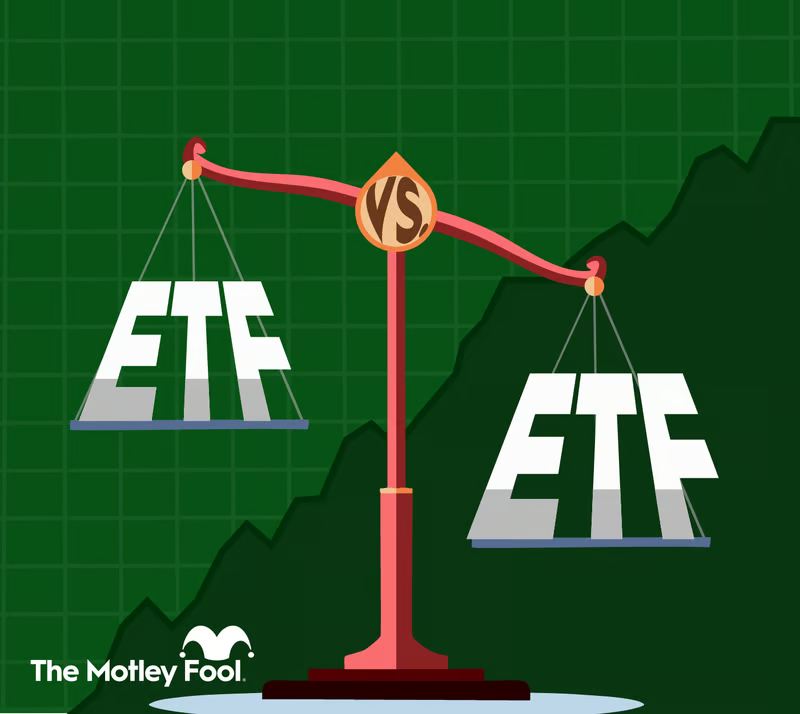
IGIB carries a slightly higher expense ratio but also offers a noticeably higher yield than VGIT. IGIB's portfolio is more diversified but more corporate-credit focused, while VGIT sticks to U.S. Treasury bonds.
VCIT and IGIB offer a nearly identical cost and yield. Both ETFs posted the same 1-year total return and experienced similar drawdowns over the past five years.