Loading market dashboard

iShares Core High Dividend ETF
HDVFinancial ServicesAMEXUS
Loading disclosure news
News and disclosures filtered by period, publisher, and event group.
Select a headline to open the full news page in the app.
The mechanics of retirement income are often simpler than the investment products marketed to provide it. A 72-year-old retiree with $1.1 million invested and an income goal of $52,800 per year, or $4,400 per month, needs a portfolio yield of roughly 4.8%. Everything else, from security selection and account placement to rebalancing decisions, revolves around... A 4.8 Percent Yield Portfolio That Lets a 72-Year-Old Sleep Through Every Quarterly Earnings Surprise

Mirum Pharmaceuticals, Inc. (Nasdaq: MIRM) and Incyte (Nasdaq: INCY) today announced that pivotal Phase 2 results from the PROGRESS study evaluating zilurgiser

Sometimes the exchange-traded fund with the most stocks wins.

iShares Core High Dividend ETF offers a more competitive expense ratio than Fidelity High Dividend ETF but has generated a lower total return over the past 12 months. Fidelity High Dividend ETF provides exposure to growth sectors like technology and financials while iShares Core High Dividend ETF prioritizes energy and healthcare.
The Vanguard High Dividend Yield ETF (VYM) and the iShares Core High Dividend ETF (HDV) both provide exposure to U.S. dividend equities, but their income profiles are built differently. For investors evaluating yield, the key distinction is how much diversification sits behind the income stream.
A well-diversified dividend ETF should offer alternatives to AI stocks.

Mirum Pharmaceuticals, Inc. (Nasdaq: MIRM), a leading rare disease company, today announced new data from its rare liver disease programs. Late-breaking result

In high-inflation, rising-rate environments where growth begins to slow, dividend stocks have proven to be a great place to camp out.

The iShares Core High Dividend ETF offers defensive exposure with a 2.90% yield, focusing on quality, high-dividend companies with strong moats. HDV's portfolio is concentrated in consumer staples, energy, and healthcare, with minimal tech exposure, making it less likely to outperform in tech-driven rallies. Given rising inflation and geopolitical uncertainty, HDV is positioned to preserve capital and provide income stability, appealing to defensive and income-focused investors.

FOSTER CITY, Calif.--(BUSINESS WIRE)--Gilead Sciences, Inc. (Nasdaq: GILD) today announced that the U.S. Food and Drug Administration (FDA) has granted accelerated approval for Hepcludex® (bulevirtide-gmod) 8.5 mg for the treatment of adults living with chronic hepatitis delta virus (HDV) infection, making it the first and only approved treatment for HDV in the United States. The FDA granted accelerated approval to Hepcludex based on reductions in HDV RNA and normalization of alanine aminotrans.

Gilead Sciences, Inc. (Nasdaq: GILD) today announced that the U.S. Food and Drug Administration (FDA) has granted accelerated approval for Hepcludex (bulevir

Vanguard High Dividend Yield ETF offers a lower expense ratio but has a lower trailing-12-month dividend yield than iShares Core High Dividend ETF. iShares Core High Dividend ETF maintains a more concentrated portfolio of 74 holdings, while Vanguard High Dividend Yield ETF holds more than 600 securities.
Oil prices and inflation have moved significantly higher, creating an increased risk of economic slowdown later this year. Many portfolios still tilt heavily toward tech and growth stocks.

The Fidelity High Dividend ETF has delivered average annual returns of 13.3% since its launch in 2016. The iShares Core High Dividend ETF has delivered a slightly higher dividend yield with a lower expense ratio.

Not all high-yield ETFs are built the same. In the case of the two major high-dividend yield funds from iShares and Vanguard, there's a clear winner.

Expense ratios, sector tilts, and risk profiles set these two dividend ETFs apart-see how their strategies shape income and growth potential for investors.
iShares Core High Dividend ETF provides nearly double the dividend yield of Vanguard Dividend Appreciation ETF for a slightly higher expense ratio. Vanguard Dividend Appreciation ETF maintains a broader portfolio of stocks while iShares Core High Dividend ETF concentrates on fewer holdings.
The iShares Core High Dividend ETF (HDV) was launched on March 29, 2011, and is a passively managed exchange traded fund designed to offer broad exposure to the Large Cap Value segment of the US equity market.

Many investors prefer growth and tech stocks to build their portfolios. Dividend stocks and ETFs might actually be the better risk/reward play.
Expense ratios, sector exposures, and risk profiles set these high-yield ETFs apart. See how their strategies align with different investor priorities.
The Schwab U.S. Dividend Equity ETF (SCHD) and the iShares Core High Dividend ETF (HDV) are two of the best high-yield equity products out there.

Sector exposure and risk profiles set these two high-yield ETFs apart, shaping their appeal for income and growth-focused investors.
While the S&P 500 has recovered from late-March lows, the low single-digit gains in 2026 for the broader market have left some investors seeking alternatives. Growth stocks have lagged some value-oriented names, particularly those offering compellingly high dividends.

Investors who have used the “buy the dip” strategy are learning the hard way that it may not work this time. Now is the time for retirees to find safe and dependable income

Farther Finance Advisors LLC increased its holdings in iShares Core High Dividend ETF (NYSEARCA:HDV) by 19.6% during the fourth quarter, according to the company in its most recent 13F filing with the Securities and Exchange Commission. The institutional investor owned 55,131 shares of the exchange traded fund's stock after purchasing an additional

iShares Core High Dividend ETF offers defensive exposure to high-quality, dividend-paying companies, prioritizing capital preservation over aggressive growth. HDV has outperformed broader indices YTD and during past downturns, delivering a 24% total return over the last twelve months with a 2.9% dividend yield. The ETF's sector concentration in consumer staples, energy, and healthcare, and its top-heavy holdings, drive stability but limit upside in bull markets.

Base Wealth Management LLC boosted its stake in shares of iShares Core High Dividend ETF (NYSEARCA:HDV) by 9.2% in the undefined quarter, according to its most recent filing with the Securities and Exchange Commission (SEC). The firm owned 68,775 shares of the exchange traded fund's stock after acquiring an additional 5,776 shares
The iShares Core High Dividend ETF (HDV) was launched on 03/29/2011, and is a smart beta exchange traded fund designed to offer broad exposure to the Style Box - Large Cap Value category of the market.

The market rotation away from growth and tech and toward undervalued areas of the market has paid off for dividend stocks. Funds emphasizing balance sheet quality and high yield have generally outperformed.
Notable differences exist among some popular high-yield exchange-traded funds (ETFs). Energy stocks are driving big gains in two high-yield ETFs run by Schwab and iShares.
DAVENPORT and Co LLC lifted its holdings in iShares Core High Dividend ETF (NYSEARCA:HDV) by 6.9% during the fourth quarter, according to its most recent disclosure with the Securities and Exchange Commission (SEC). The firm owned 223,516 shares of the exchange traded fund's stock after acquiring an additional 14,461 shares during the
The 10-year Treasury yield sits at 4.23% today, and that number matters more than most retirees realize. It represents the baseline. That is, what you can earn with zero risk. Any dividend ETF benchmarked against Treasurys would need to clear that bar in total return terms, or at least come close enough in yield that... The 3 Best Dividend ETFs to Build Lasting Retirement Income in 2026.

Advisory Services Network LLC raised its position in shares of iShares Core High Dividend ETF (NYSEARCA:HDV) by 23.7% in the third quarter, according to the company in its most recent Form 13F filing with the Securities and Exchange Commission. The firm owned 175,123 shares of the exchange traded fund's stock after acquiring

Recent price action suggests the iShares ETF deserves consideration. This ETF was in the right place at the right time entering this year.

Despite equity valuations in the growth sectors reaching stretched levels and market volatility on the rise, high-dividend stocks have been one of the best performers to start 2026. In turn, this is translating to greater appeal for high-dividend-yielding ETFs.
HDV charges a marginally higher expense ratio than SCHD but has outperformed over the past year. SCHD offers a higher dividend yield and greater diversification across its 101 holdings.
Both the iShares Core High Dividend ETF (NYSEARCA:HDV ) and the State Street SPDR Portfolio S&P 500 High Dividend ETF (NYSEARCA:SPYD ) are popular names, with billions in capital flowing to them.

FDVV comes with a higher expense ratio but has outperformed HDV over the past year and five-year period. Both ETFs offer nearly identical dividend yields, yet their sector exposures differ significantly.

Explore how sector focus and portfolio diversity set these two leading dividend ETFs apart for income and growth-minded investors.
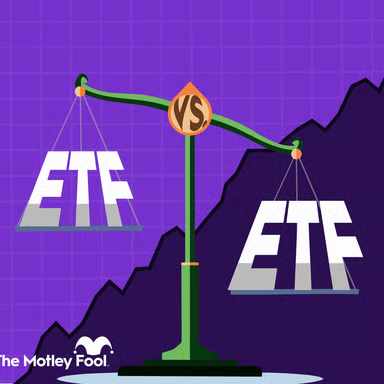
HDV charges a significantly lower expense ratio and offers a higher dividend yield than NOBL. HDV has posted stronger 1-year and 5-year total returns, with less severe drawdowns and lower beta.

VYM charges a lower expense ratio and holds a much broader basket of stocks than HDV HDV currently offers a higher dividend yield and tilts more heavily toward energy and consumer defensive companies Both funds showed similar drawdowns over five years, but VYM delivered stronger total returns over the past year

Launched on March 29, 2011, the iShares Core High Dividend ETF (HDV) is a passively managed exchange traded fund designed to provide a broad exposure to the Large Cap Value segment of the US equity market.